In brief
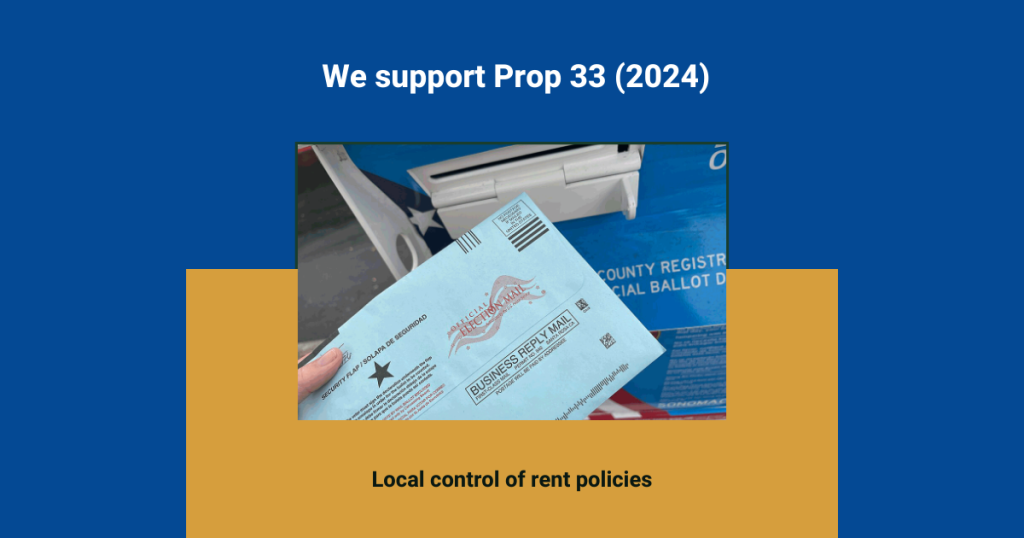
We support Prop 33 (2024) because it empowers local governments to determine which rent policies are best for their communities. Escalating rents are a significant driver of poverty in California. Rent policies can be important methods for protecting the vulnerable and avoiding the tragic human costs of displacements, destabilizing families and communities.
We discount the importance of “pure economic theory” because the reality of rental housing bears little relationship to academic theory. In contrast, escalating rents are a verifiable source of distress for many families. We note that virtually all rent policies enacted in California guarantee landlords the right to a fair return. Still, they do not guarantee tenants the right to stay out of poverty. Prop 33 does not create new rent policies; it simply eliminates state-imposed restrictions on what local governments can do.
Our Housing and Shelter Task Force recommends support for this ballot item.
Download a copy of this resource here.
In brief
What would Prop 33 do?
Many cities, including San Francisco and Los Angeles, limit the amount a landlord can raise the rent each year — a policy known as rent control. However, for nearly 30 years, California has restricted what local governments can decide on those limits via a law known as Costa-Hawkins. Cities cannot set rent control on single-family homes or apartments built after 1995. And landlords are free to reset their rental rates when new tenants move in.
If Proposition 33 passes, that would change. Cities would be allowed to control rents on any type of housing, including single-family homes, new apartments, and new tenants.
Why Local Governments Should Be Empowered to Impose Rent Controls in California
The debate around rent control is complex and multifaceted. Here are some arguments in favor of empowering local governments to impose rent controls in California – support for Prop 33:
Addressing the Housing Affordability Crisis
- Local Needs: Local governments better understand the specific housing market conditions in their area and can tailor rent control policies to address unique challenges.
- Protecting Tenants: Rent control can protect tenants from excessive rent increases, preventing displacement and maintaining community stability.
- Stabilizing Neighborhoods: Rent control can help stabilize neighborhoods and prevent the displacement of long-time residents by preventing rapid rent increases.
Democratic Local Control
- Local Decision-Making: The communities that are directly affected are in the best position to set rent control policies. Local governments are more responsive to their residents’ needs.
- Diverse Approaches: Different communities have different housing markets and needs. Local control allows for a variety of approaches to address the housing crisis.
Mitigating the Negative Impacts of Market Forces
- Controlling Costs: Rent control can help mitigate the impact of rising housing costs on renters, particularly low-income households.
- Preventing Displacement: Rent control can help prevent residents’ displacement due to rising costs by limiting rent increases.
Promoting Economic Stability
- Consumer Protection: Rent control can protect consumers from unfair rent increases, boosting consumer confidence.
- Supporting Local Businesses: Stable neighborhoods with a mix of income levels can help local businesses and create a thriving community.
It’s important to note that there are counterarguments to rent control, such as the potential for decreased housing supply and unintended consequences. However, proponents argue that carefully crafted rent control policies can be an effective tool to address the housing affordability crisis in California.
Why Faith Communities Might Support Local Rent Controls
Many faith communities are deeply rooted in principles of social justice, equity, and compassion. These values often align with the goals of rent control policies. Here’s why faith communities might support local governments imposing rent controls in California:
Alignment with Faith Values
- Protecting the Vulnerable: Rent control can protect low-income individuals and families from displacement, aligning with the biblical principle of caring for the poor and oppressed.
- Promoting Community Stability: Many faith communities value solid and stable communities. Rent control can help prevent rapid turnover and maintain the social fabric of neighborhoods.
- Addressing Economic Inequality: Rent control is a tool to address economic inequality, a concern shared by many faith-based organizations.
Practical Considerations
- Congregation Demographics: Many faith communities serve low-income and working-class populations disproportionately affected by rising housing costs. Rent control can help protect these members.
- Social Services: Faith-based organizations often provide social services to the community. Rent control can reduce the number of people needing assistance and allow organizations to focus on other needs.
- Community Building: Stable housing is essential for individuals and families to thrive. Rent control can contribute to stronger, healthier communities, which benefits everyone.
Addressing Concerns
It’s important to note that not all faith communities will agree on rent control or on support for Prop 33. Some may be concerned about unintended consequences, such as decreased housing supply or economic impacts. Open dialogue and careful consideration of these concerns are essential.
By understanding the potential benefits and challenges of rent control, faith communities can make informed decisions about whether to support local government efforts to implement such policies.
Read the articles below or the Housing and Shelter Task Force for further information on housing matters.
General Information on Ballot Items
For more information and recommendations on all of the ballot items, please consider these sources:
- California League of Women Voters – Ballot Recommendations
- California Council of Churches IMPACT – Recommendations
- Friends Committee on Legislation of California – Recommendations
For more information on the ballot items themselves, please consider these sources: