In this election season, faith voices are needed in the work for housing justice in our county. So, we organized a convening and invited our faith leaders to hear about specific housing issues and the advocacy tools our communities can use to respond to God’s call to help the needy.
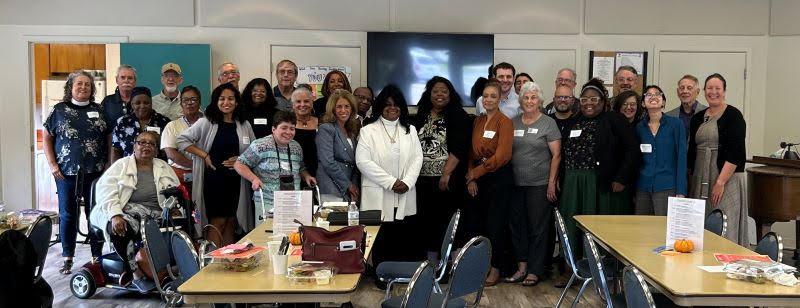
Our Faith-Rooted Housing Justice Convening was on Wednesday, September 18, 2024. The event was hosted at Concord United Methodist Church and was sponsored by the Multi-Faith ACTION Coalition, Hope Solutions, and East Bay Housing Organizations. We had a room full, and another large cohort participated via Zoom!
When we work together to address our county’s affordable housing crisis, the task seems less daunting. This was wonderfully evident as clergy and faith leaders from multiple traditions provided critical moral grounding to housing justice issues. We also invited participants to share their own experiences. And a number of updates were provided on ballot and legislative topics.
A detailed recap is offered below. And a full recording is also available on YouTube.
A Detailed Recap
Here’s a full recap of the Faith-Rooted Housing Justice Convening we held on Wednesday, September 18, 2024. The event was held at Concord United Methodist Church and was sponsored by the Multi-Faith ACTION Coalition, Hope Solutions, and East Bay Housing Organizations.
11:00 AM REGISTRATION & ICEBREAKER
Attendees had the opportunity to register and eat lunch while participating in an icebreaker activity: What does Housing Justice Mean to you?
11:15 AM WELCOME, GROUNDING, OPENING PRAYER
The event was co-convened by Pastor Marie Wilson of Concord United Methodist Church and Jasmine Tarkoff, a consultant with Hope Solutions and co-convener of the Multi-Faith ACTION Coalition. Pastor Marie welcomed attendees to Concord United Methodist Church. Jasmine Tarkoff welcomed attendees to the convening, recognized the co-sponsoring organizations, and invited attendees to open their hearts and minds to the sacred conversation about faith, justice, and housing. Pastor Marie then led the group in an opening prayer.
11:30 AM OUR FAITH TRADITIONS AND HOUSING JUSTICE
Four faith leaders were invited to speak about how their spiritual traditions inform their understanding of housing justice.
- Dr. Sedique Popal of the Noor Islamic Cultural and Community Center spoke about Zakat, Islam’s fourth pillar. This pillar calls for giving money to charities to provide homes, food, and clothes for those who lack those things. Dr. Popal also discussed the concept of a collectivist culture within Islam, which dictates that families and tribes take care of their own and do not leave their members to struggle with poverty or homelessness.
- Rabbi Aaron Torop of Temple Isaiah discussed the importance of recognizing that housing is part of a broader constellation of needs that must be met for people to thrive. He quoted from the Book of Isaiah, which calls on people to share their bread with the hungry and to take the wandering poor into their homes. He also noted that Jewish law prohibits requiring people to sell their property in order to receive assistance.
- Deacon Peter Nixon of St. Bonaventure Catholic Church spoke about Catholic social teaching, emphasizing that housing is a foundational need that must be met for people to live a human life with dignity. He also noted that a home is a place where a community of persons comes together to create and live out their lives. Deacon Nixon closed by sharing that the lack of affordable housing in the Bay Area is a moral and spiritual crisis.
- Reverend Dr. Leslie Taylor of First Christian Church of Concord spoke about the Protestant Christian understanding that all people are created in the image of God and that denying anyone access to basic necessities like housing violates their inherent dignity. She noted that the Bible repeatedly emphasizes the importance of caring for the poor and vulnerable and that housing justice involves ensuring that everyone has access to safe, affordable, and stable housing.
11:45 AM SMALL GROUP ACTIVITY AND SHARE-OUTS
Attendees were broken into small groups to share stories about times when they successfully or unsuccessfully connected their faith teaching to housing justice advocacy. Some successful examples included a church member who helped a woman facing eviction find childcare clients so that she could make her rent and churches that host Winter NIghts programs for families experiencing homelessness. Some unsuccessful examples included pushback from community members who expressed NIMBY sentiments when churches attempted to build affordable housing in their neighborhoods.
12:00 PM HOUSING NEEDS IN CONTRA COSTA COUNTY
Three housing policy consultants from Hope Solutions, Deborah Carney, Irma Bodden, and William Goodwin, shared stories about their lived experiences with housing insecurity and presented data about the state of housing in Contra Costa County.
- Deborah Carney shared the story of Rose, a homeless single mother of three autistic children who was living in her car in a Lucky’s parking lot. Ms. Carney highlighted the lack of family shelters in Contra Costa County, noting that the only family shelter in the county is in Martinez and is often full. She also underscored the high cost of housing in the county and the need for more affordable housing.
- Irma Bodden shared her experiences as a Section 8 voucher holder, noting that landlords were once willing to accept vouchers, but that has become increasingly rare. She discussed the difficulty of finding affordable housing with a voucher and the fact that clients can risk losing their vouchers if they cannot find a home in time. Ms. Bodden also spoke about the growing number of senior citizens and veterans who are becoming unhoused.
- William Goodwin presented data about the lack of affordable housing in Contra Costa County, including the fact that only 24 affordable homes are available for every 100 extremely low-income renter households. He shared that rent in Contra Costa County has increased by 25% since the year 2000, while the median renter household income has decreased by 3%. Mr. Goodwin noted that when housing costs are factored in, the poverty rate in the county rises from 10.8% to 16.1%.
12:15 PM PROPOSITION 5
Reverend Sophia DeWitt, Chief Program Officer for East Bay Housing Organizations (EBHO), spoke about Proposition 5, which will be on the ballot in November. Proposition 5 would allow local communities to pass bonds for affordable housing and infrastructure with a 55% vote. Reverend DeWitt highlighted the importance of this proposition, noting that it would give local communities more power to address their own needs. She also emphasized the connection between Proposition 5 and SB 4, the Affordable Housing on Faith Lands act, which removes regulatory restrictions on building affordable housing on faith lands. Reverend DeWitt closed by urging attendees to vote for Proposition 5 and to encourage their congregations to do the same.
12:25 PM OTHER TOPICS FOR OUR ATTENTION AND VOTER REGISTRATION
Greg Colley of St. Bonaventure and the Multi-Faith ACTION Coalition spoke about other important ballot measures and local housing issues.
- Proposition 33 prohibits state limitations on local rent control, which allows local governments to decide which rent policies are best for their communities. Mr. Colley noted that rent control protects vulnerable renters and that evictions have a morally untenable human cost. He encouraged attendees to consider this proposition’s moral and practical implications and support its passage.
- Proposition 6 would end involuntary servitude as punishment for a crime in California. Mr. Colley pointed out that this practice disproportionately impacts certain racial groups and is not aligned with faith values. He urged attendees to support the passage of Proposition 6.
- Proposition 32 would raise the minimum wage to $18 an hour for employees of companies with more than 26 employees. Mr. Colley spoke about the moral imperative of a living wage and the importance of fair working conditions. He noted that fair wages are a key component of a just economic system and encouraged attendees to support the passage of Proposition 32.
- Affirmatively Furthering Fair Housing (AFFH) is a state-mandated requirement for local governments to plan how all residents’ housing needs will be met. This includes promoting higher density zoning with a mix of affordability in areas with high resources. Mr. Colley noted that there has been resistance to AFFH from residents of high-resource areas and encouraged attendees to follow AFFH work in their cities and to provide moral guidance to their elected officials.
- Criminalization of Homelessness Mr. Colley discussed the negative developments with regard to the criminalization of homelessness, noting that sweeps of encampments are increasing while the number of places for unhoused people to go is shrinking.
Jazzman Cardona of Hope Solutions spoke briefly about the importance of voter registration and encouraged attendees to register to vote and to encourage their congregation members to do the same. She also shared some important information about the rules and regulations around voter registration.
12:40 PM WHAT CAN FAITH AND LAY LEADERS DO?
Melody Howe Weintraub of the Multi-Faith ACTION Coalition and Temple Isaiah led a discussion about what faith and lay leaders can do to support affordable housing and other social justice issues. She encouraged attendees to educate their congregations about the issues, provide sermons about housing justice, and include information about the propositions in their newsletters and bulletins. She also clarified that it is legal for faith-based and non-profit organizations to engage in policy advocacy, as long as they do not endorse specific candidates. Attendees shared ideas from their own congregations, such as hosting candidate forums, creating voter guides, and organizing community meetings.
12:50 PM CALL TO ACTION PLEDGE CARD AND WRAP UP
Attendees were invited to fill out a pledge card indicating how they would take action on the issues discussed at the convening.
12:55 PM WRAP UP AND CLOSING PRAYER
Jasmine Tarkoff thanked the sponsoring organizations, the speakers, and the attendees for their participation in the convening. Dr. Karen Hernandez, the executive director of the Interfaith Council of Contra Costa County, closed the convening with a poem by Mary Oliver.